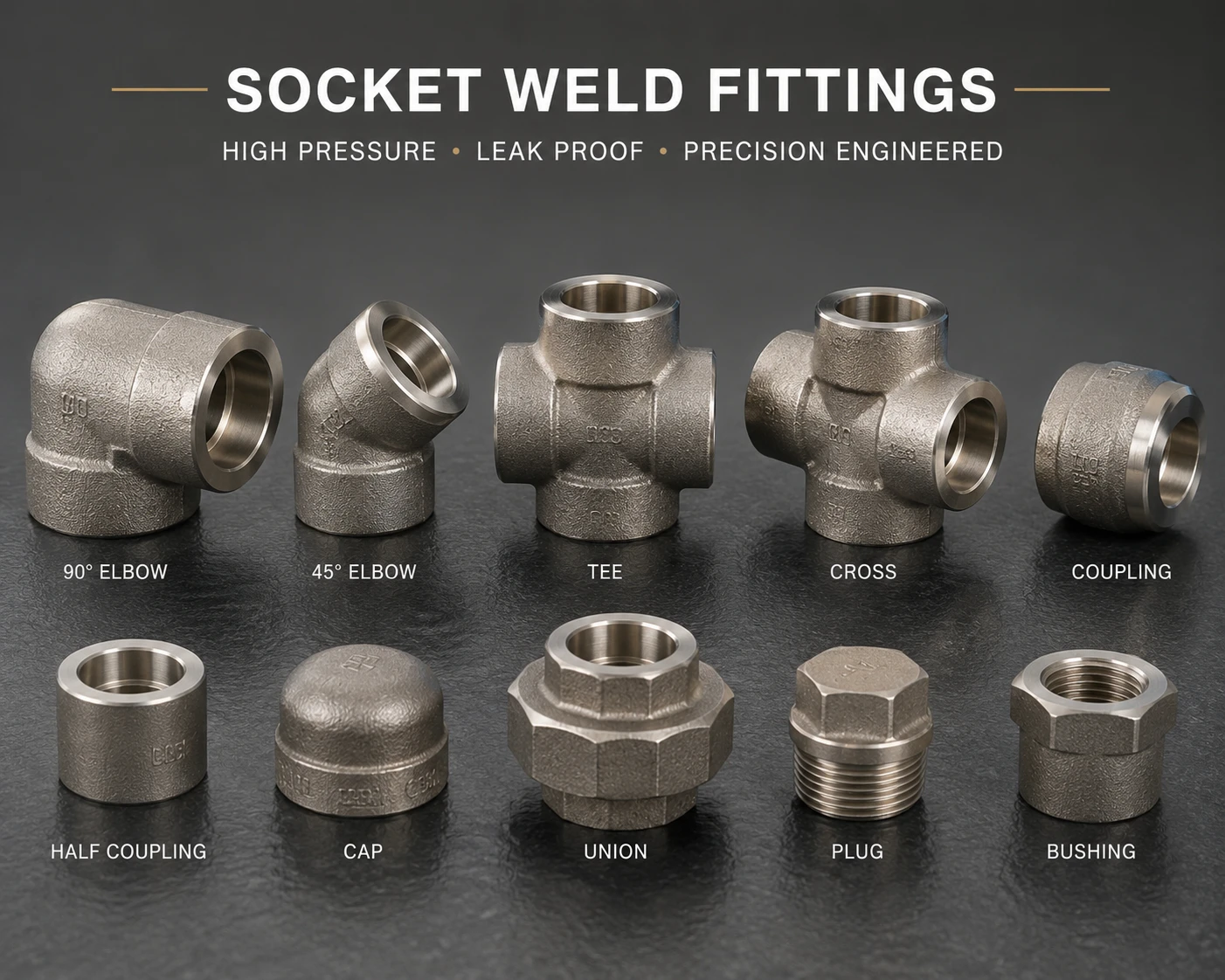
1. Overview of Fitting Standard Designations
Industrial piping networks rely on pipe fittings to alter flow direction (elbows), split fluid streams (tees), reduce line dimensions (reducers), or seal ends (caps). The choice between seamless butt weld fittings and high-pressure forged fittings depends on pipe diameter, pressure rating, fluid hazard level, and non-destructive examination (NDE) requirements.
2. Detailed Structural Comparison Matrix
| Design Parameter | ASME B16.9 Butt Weld Fittings | ASME B16.11 Forged Socket Weld | ASME B16.11 Forged Threaded |
|---|---|---|---|
| Size Availability | NPS 1/2" up to NPS 48" | NPS 1/8" up to NPS 4" (Commonly ≤ 2") | NPS 1/8" up to NPS 4" |
| Pressure Classes | Matches mating pipe wall schedule | Class 3000, Class 6000, Class 9000 | Class 2000, Class 3000, Class 6000 |
| Internal Flow Turbulence | Smooth, flush ID transition | Crevice gap at socket root creates turbulence | Internal thread steps produce turbulence |
| NDT Inspection Method | 100% Radiographic Testing (RT) compliant | Liquid Penetrant (PT) / Magnetic Particle (MT) | Visual / Pressure Leak Testing |
| Crevice Corrosion Risk | Zero crevice pocket | Moderate risk at 1/16" expansion gap | High risk in root of male/female threads |
3. Fabrication & Welding Considerations
When installing Socket Weld fittings, piping fitters must insert the pipe into the socket hub until it bottoms out, and then retract the pipe by approximately 1.6 mm (1/16 in) before applying the fillet weld. Failing to leave this thermal expansion gap causes high axial stress at the fillet root when the pipeline heats up during operation, leading to premature fatigue cracking.
Conversely, Butt Weld fittings require precise bevel preparation (37.5° ± 2.5° bevel angle per ASME B16.25) and root gap alignment. Full-penetration butt welds offer superior fatigue life under cyclic thermal expansion and severe water hammer vibrations.